An Experiment, On Purpose
On living as an artist in a world that often wants the statue, not the studio.
The first in Notes from an Experiment in Reclamation — a series of reflections from inside Art & Alchemy, The Unlearning Studio's monthly virtual workshop.
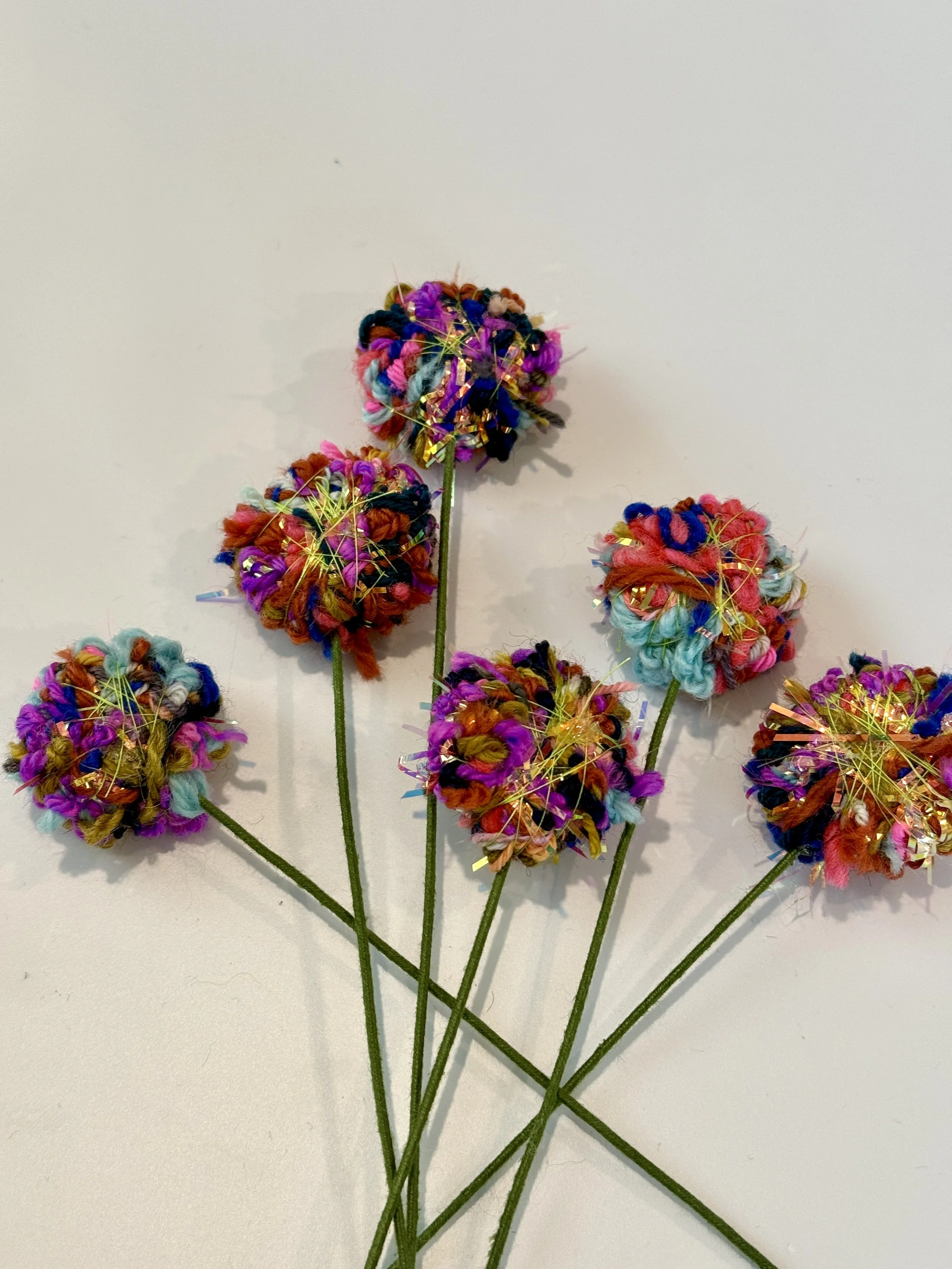
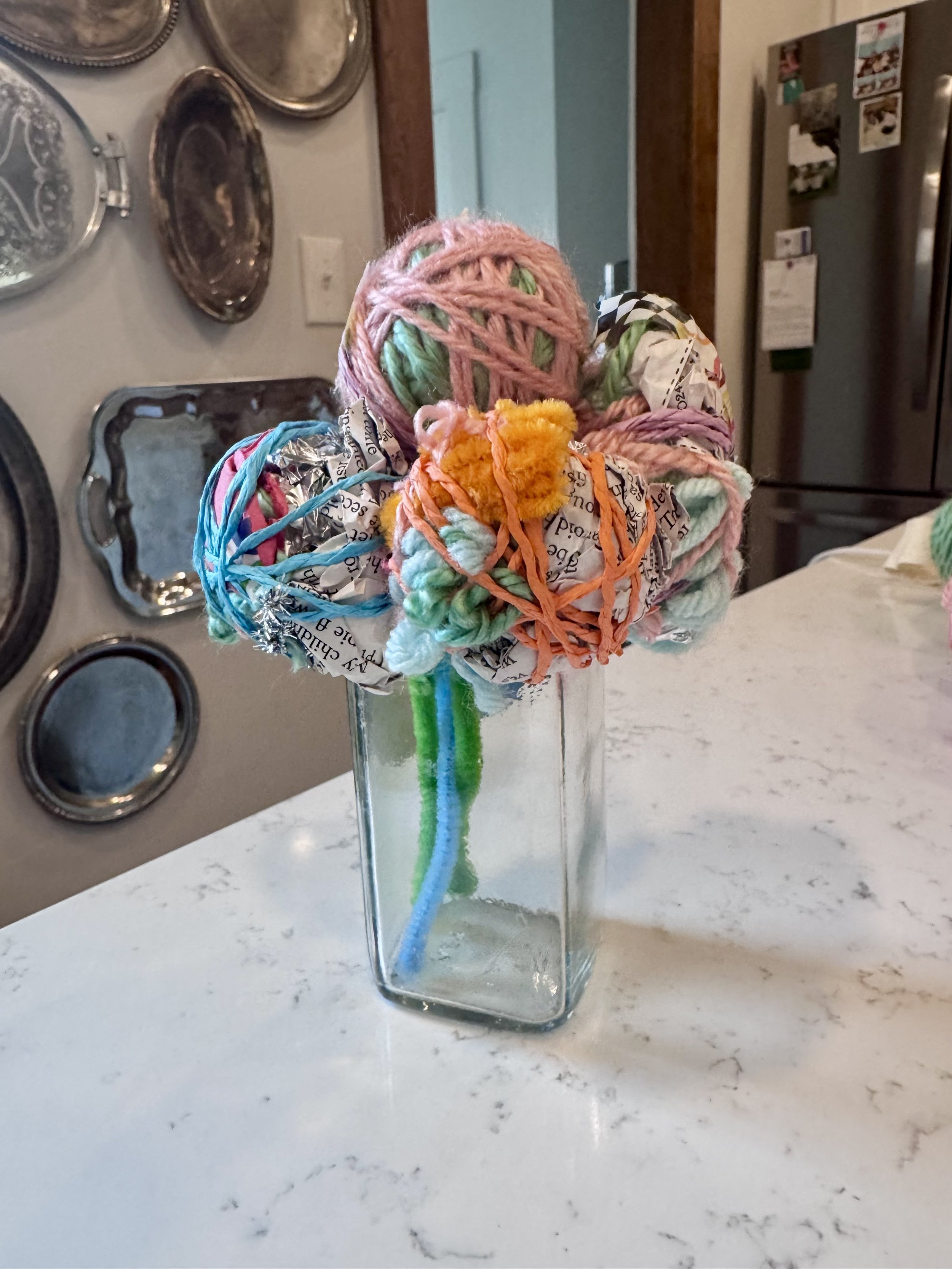
Flowers made from yarn scraps at one of our Art & Alchemy gatherings.
In 2022, I sent an email to four friends across the country who, for the most part, didn't know each other.
I'd been noticing, in conversations with each of them separately, a similar thread — a desire to live more intentionally amidst the world's complexity, to be in real company across the unfolding of a life, to inhabit a kind of friendship structured around meaning more than around "catching up."
I didn't know what to do with the noticing exactly, but as is common in my life, I felt a sense of rightness when I imagined us together in my mind's eye — a feeling of connection that lived beyond words and logic, and a call to act on it.
So I wrote everyone an email, shared my intuition, and proposed an experiment: What if we gathered, once a month, for ninety minutes, around whatever was alive in us — without pre-deciding what our space would be, whether it would last, or what it would become? I framed it as a "co-held space with a light-touch agenda at most, born of deep trust in what emerges when people come together in commitment and openness."
Four years later, this Creative Coven (as my friend Rob named us) is still meeting. We've only been in the same room together once. Facilitation rotates. The structure is light, emergent, and shifts with the seasons we're in. Sometimes we start with a "How is everyone, really?" Other times, someone brings a question or provocation, and we let the conversation go where it needs to without expectation of where it lands. We've done business consultancies for each other, thought-partnered around major life decisions, and celebrated milestones. Earlier this year, we invited an expert in human design to come chat with us, and have been sense-making our individual and collective worlds through that lens for the last couple of months. Who knows where we'll head next.
We've seen each other through births and adoptions, health crises and breakthroughs, shifts in self-perception, reclamations of agency. Though we are scattered across the country (and sometimes the world), our container holds anyway.
This is an incredibly important community in my life, and I often marvel at our beginning. I knew so very little about what would unfold when I sent that email four years ago. All I really had was a hunch and a willingness to give it a go.
How glad I am that I didn't turn away from my own inner sensing.
I've been reflecting lately on how much of my life has emerged this way.
Not through five-year plans or "strategic clarity" — but through small experiments I've let live as explorations. Through hits of intuitive knowing I've trusted before I've been sure of them. Through containers I've started without knowing what they would become.
Creative Coven was one of those. The relationship that became my husband, Daniel, is another. Wayfinding Wisdom, the executive coaching and consulting practice I started over a decade ago, another still. My newest endeavor, The Unlearning Studio — and one of its earliest spaces, Art & Alchemy, the monthly workshop that's the seed of everything I'm about to tell you — is the most recent.
I want to say plainly, because the world sometimes paints a different picture, that I don't think this means my life has been built haphazardly or without intention. It's emerged through a particular way of moving in the world that I've come to trust — one filled with intentionality, yet held loosely enough to let life have a say.
I hold an orientation that I'm perpetually co-authoring my life with life itself. I have agency — to follow my intuitions, to create, to act, to respond to what's presented to me. And I also don't get to control or decide everything. So I walk through the world listening at the intersection of what I want and what life seems to be asking of me. Then I respond to what I hear.
This requires me to listen into the contours of my own inner world, feel into its nuances, and trust what I find there — as much as it requires me to pay attention to what's going on outside and around me. When I land on something that feels internally true, I follow it. When it calls me to put things out into the world, I practice doing that before they're finished. Then I stay close to what's actually happening as the things I create begin to take shape. I let what's being formed teach me what it wants to become.
I don't do this perfectly. Like anyone, I over-dial and under-dial — moving too fast on some things, holding others too long, missing the signal sometimes and second-guessing it other times. To be clear, I'm describing my orientation here, not a method I've mastered.
Someone once told me, “This is how an artist lives” — and gave the example of Leonardo da Vinci spending long hours with his blocks of raw marble, waiting to see what was already in them before ever picking up a chisel.
This resonated. I realized I'd been doing some version of living as an artist my whole life without a name for it — the long hours I've always spent being with something (an idea, a material, a relationship) before acting on it. The way listening lived for me as the work, not a warm-up to it.
Having language to support how I instinctually move through the world was a permission slip to live more fluidly as myself. Still, there is a pressure I feel living this way inside systems and relationships that don't always have much patience for it — that want the chisel to start moving. Where sensing is seen as woo-woo, where time spent listening looks, from the outside, like time wasted, and where the expectation is that the statue emerges from the studio fully formed.
As a professional coach and facilitator, I sit with people as they sense-make the relationship between their inner world and outer circumstances, and I can tell you a good deal of us are walking around feeling the pressure to be further along than we honestly are. To know what we want before we've had time to find out. To skip the long hours with the marble — the not-knowing, the sensing, the waiting — because the world wants the statue, not the studio.
It makes sense. Think of all the models we have for how to build something: figure out what you want to do first, validate the idea, refine it, then release it polished with a great marketing campaign. I'm not against polish. And I've seen too many beautiful possibilities die in the validation phase over polish.
The experiments that have worked best in my life are the ones I've let stay experiments for a looooong time.
So the part of me that has agency in this world is continually reclaiming the permission to live as the artist I am. To listen before I act. To begin before I'm certain. To let the long hours with the marble count as the work — even in the face of the world's impatience.
This is how Art & Alchemy began.
A year ago, in a Coven meeting, we were reflecting on what we wanted to be up to more of in the world. I shared a story from a workshop I'd recently facilitated on creating clarity in conflict — one where I'd introduced a set of conversational moves and framed the practice time as "Let's try these on, play, and see what happens."
Initially people did what they usually do when I invite them to jump right in — hesitate and hedge. But with some encouragement they got into the play, and within a few minutes the room was full of lightness, laughter, and legitimate experimentation around a topic that often feels quite challenging.
At the end, when I asked the team for insights on their experience, one woman raised her hand and said:
"I learned more in these two hours of trying on moves than I have in years of reading about how to communicate better. Not because you made us role play — I hate role plays — but because you invited us to actually play. This might sound silly, but I don't think I ever thought learning something hard could be fun. Today was. And I needed that."
Her comment landed in me and gave voice to something that's troubled me in learning spaces for a long time.
We've made learning so serious. So front-of-the-room, take-notes, master-the-framework serious. Especially when the thing being learned is hard — about conflict, about communication, about ourselves. The harder the topic, the heavier the container we tend to build around it. As if seriousness and depth were the same thing.
But what I saw in that workshop — and what I've seen in every learning space I've ever loved — is that depth often arrives by a different door. Not through the framework. Through the play. Not through talking about how to do the thing. Through doing the thing, in low-stakes conditions, with other people willing to try it alongside you.
I said something to the Coven group that day that I'd been chewing on for a while:
It pains me how many of us think learning has to be hard and heavy. That unlearning has to be hard and heavy. What would it mean to grow lightly? What would it mean to unlearn not by talking about how to unlearn — but by putting ourselves in conditions where unlearning just… happens?
(Talking about the work instead of doing the work is one of my pet peeves. So is the assumption that anything requiring real effort or consistency must also be heavy, time-consuming, or hard. Coven has always been my evidence to the contrary — we're not talking about how to do friendship differently. We're doing friendship differently. Ninety minutes a month. No rigorous intellectual pondering required.)
The group challenged me to try something. Make a small space. See what happens.
A few months later, I'd invited my friend Megan — another human who learns through her hands — to join me in the experiment, and Art & Alchemy was up and running. A virtual circle, once a month, where we make something with our hands and sit with one question. Light touch. No curriculum. No homework. Just the conditions for something to happen, and trust that the right thing will.
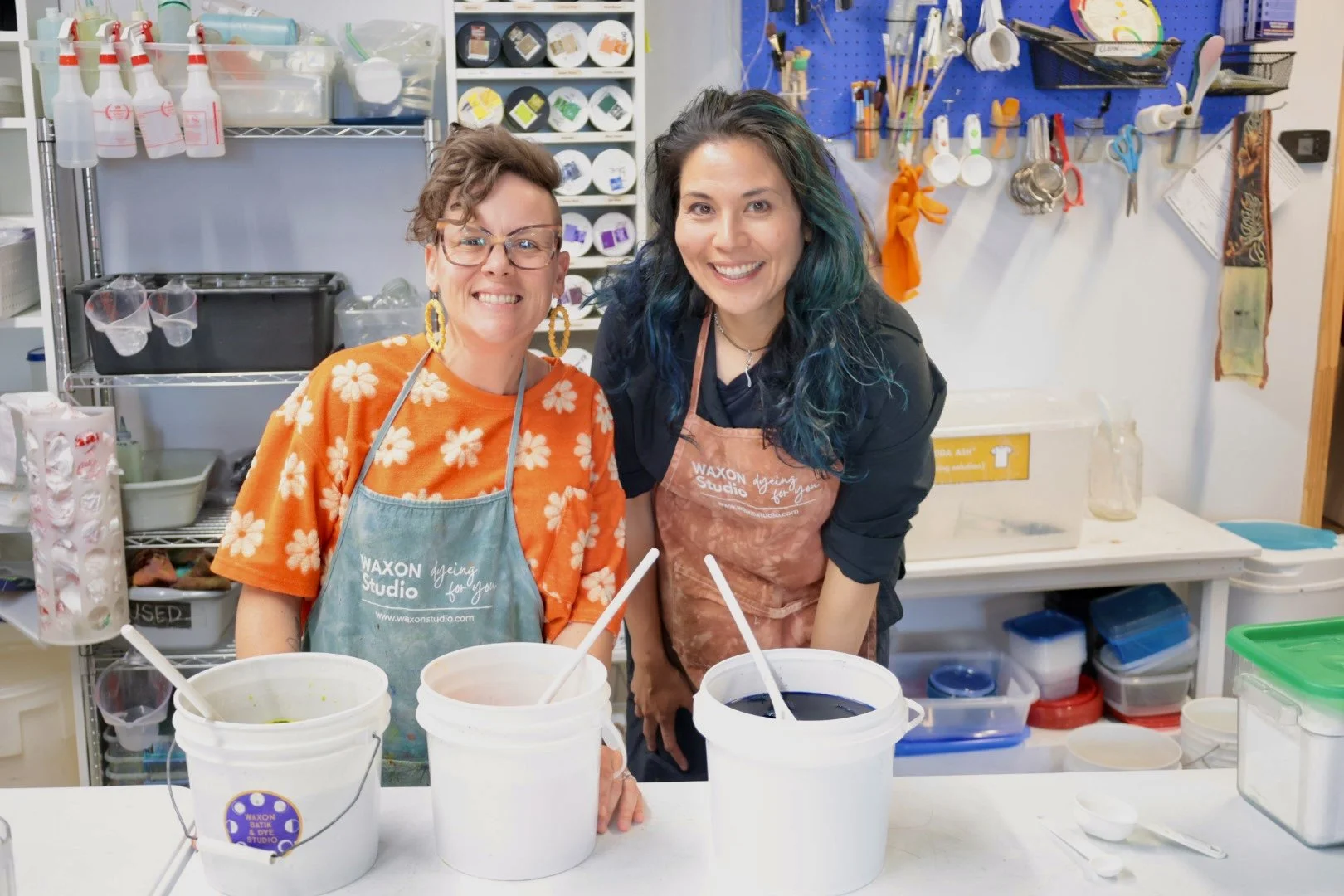
My co-facilitator Megan and I learning how to batik together.
For me, Art & Alchemy is an experiment in a few different questions at once.
What if some of the big things that matter most to the evolution of our world — unlearning the patterns we've been socialized into, reclaiming the parts of ourselves we set down somewhere along the way, finding our way back to creativity and aliveness — don't always have to happen through on-the-nose professional development? What if they can happen in the quiet of a Sunday afternoon, while our hands are busy and our minds are softening?
What if the depth, meaning, and connection we're looking for doesn't always require a curriculum, a workbook, or a six-week container? What if a small group, a good question, and the simple act of making something together is enough?
What if the work of becoming ourselves can also be — sometimes, genuinely — light and fun?
I don't have this figured out. I'm seven months in on this experiment, and it's still teaching me. Megan and I decided to take the summer off from our monthly gatherings and restart our circle again in September. In the meantime, I thought I'd write to sense-make my learnings. After all, the pause is part of the practice.
So that's what this series is. Notes from inside the experiment, not from the other side of one. Over the next several months, I'll be sharing what Art & Alchemy has been teaching me — about how people come back to themselves, about what light-touch spaces can hold, about what I've had to unlearn as a facilitator in order to make room for what actually wants to happen in the room.
These notes are also, quietly, the seeding ground for what's coming next. This fall, I'm moving toward a new experiment — a space called Reclamation. What is it exactly? Don't we all want to know. ;) It's taking shape, evolving out of themes from my coaching and facilitation work, Art & Alchemy, and my own personal practices in art-making and living. Whatever it ends up looking like, I sense it's the next door into the work I'm doing in the world. More on the shape as it crisps up in my mind's eye.
For now, though, I just want to take you through what I've been learning. Because some of it might be useful to you, too — wherever you are in your own experiments and explorations.